
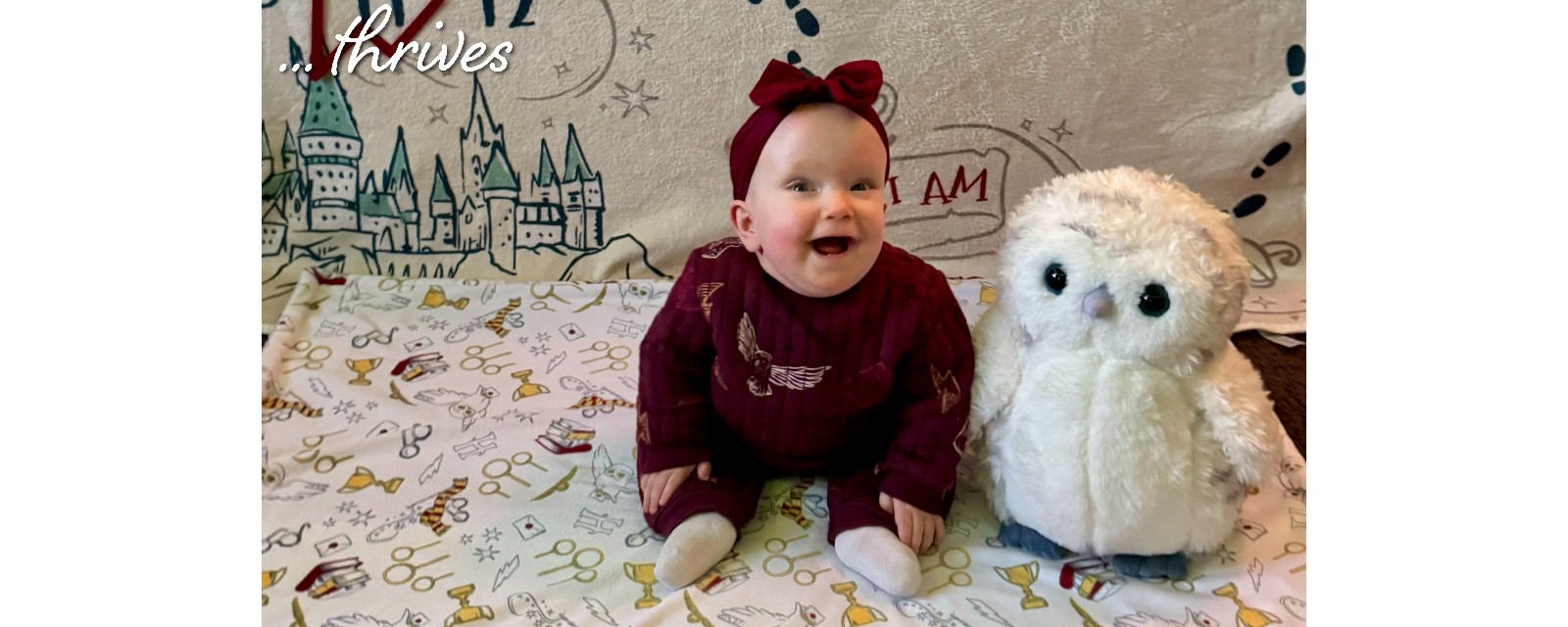
When 1-year-old Lucinda Owens claps her hands, waves hello, and sits up to play with her books, her parents see a miracle. The toddler from Jeffersonville, Indiana, who was born with the most severe form of spina bifida, is now reaching milestones once thought impossible, thanks to a groundbreaking surgery and multidisciplinary care at Norton Children’s.
The moment everything changed
Autumnn Owens and her husband, Cody, were so excited to grow their family. At 21 weeks pregnant, they were excited to see their baby at the routine anatomy scan. But the ultrasound images of their baby girl, Lucinda, revealed something that no one was expecting.
“We were told she had an abnormality on her spine that looked like it could be spina bifida with possible scoliosis,” Autumnn said.
Suddenly, their family’s normal pregnancy journey was thrust into a whirlwind of learning about spinal conditions, visiting fetal medicine specialists and so many unknowns about what their daughter’s life would look like.
Following Autumnn’s referral to specialists with Norton Children’s Maternal-Fetal Medicine, a part of Norton Women’s care, Lucinda received a diagnosis that was even more serious than initially expected: myelomeningocele. It is the most serious type of spina bifida, and is a condition where the spinal cord develops outside the body.
Lucinda’s case then became more complex. After more detailed imaging, doctors learned she didn’t have scoliosis, but myelokyphosis, a 90-degree curve in her spine. This severity of the curve meant that fetal surgery that typically addresses spina bifida before birth could not be done. She also had hydrocephalus, an abnormal buildup of fluid on the brain that requires close monitoring.
“We spent so much time worrying about what quality of life our daughter would have,” Autumnn said.
A case unlike any other
When Lucinda was born Feb. 11, 2025, via cesarean section (C-section) at 37 weeks, her parents couldn’t hold or touch her — her spinal cord had no skin protecting it and was extremely vulnerable.
Kent L. Walker, D.O., pediatric orthopedic spine surgeon with Norton Children’s Orthopedics of Louisville, had never seen anything quite like Lucinda’s case in his career.
“In 2026, due to medical advancements, the occurrence of infants born with spina bifida and an exposed spinal cord is rare,” Dr. Walker said.
As soon as Lucinda was born, neurosurgery, orthopedics and plastic surgery teams with Norton Children’s knew they would need to work quickly to repair Lucinda’s back and enclose the spinal cord to allow her to survive. But it wasn’t going to be easy.
Thinking outside the box
The surgeons described the challenge as unprecedented. The team needed to find a way to correct Lucinda’s severe spinal curve, but if they removed too much bone or allowed the spine to fuse, it would impact her ability to keep growing.
“There is limited literature regarding the management of this complex issue; therefore, an innovative approach was required in addressing her case,” Dr. Walker said.
Their solution was groundbreaking: Use a specialized implant typically reserved for severe scoliosis surgery. The device would be strong enough to hold the spine in proper alignment but small enough for a newborn, and most importantly, it would allow for compression of the bones without causing them to fuse together.
“We didn’t have many other options, so we agreed to try this and were very optimistic it would be successful,” Dr. Walker said. “The goal of the surgery was to remove as little bone as possible but remove enough to allow for the wound to be closed.”
On Feb. 13, when Lucinda was just 2 days old, the multidisciplinary team gathered for a surgery that would last seven hours. Dr. Walker and Norton Children’s Neuroscience Institute pediatric neurosurgeon Thomas M. Moriarty, M.D., worked to carefully correct the spinal deformity and place the innovative implant, while pediatric plastic surgeon Mark E. Chariker, M.D., closed the massive opening in Lucinda’s back.
The surgery was successful. Lucinda’s spine, which had protruded at a dangerous 90-degree angle, was brought into proper alignment. Her exposed spinal cord was finally protected, while the implant held it in place.
48 days in the NICU
Lucinda’s journey was far from over. She would spend 48 days in the Norton Children’s Hospital neonatal intensive care unit (NICU), which included another surgery to address her hydrocephalus and a procedure on her skin to help her wound continue to heal.
For Autumnn and Cody, the weeks in the NICU were long and emotionally taxing. They visited Lucinda every day, spending all day at their daughter’s bedside, then returning home each evening to be with their son, Joey.
“Leaving your baby there every night is absolute torture for parents,” Autumnn said. “But her team was great, and we had several nurses who impacted us hugely. We will never forget them.”
While recovering from spinal surgery, Lucinda started meeting exciting milestones. Seventeen days after Lucinda’s birth, Autumnn and Cody were able to hold their daughter for the first time. Within a month of that, she could lie on her back, and within a few days, she could start to wear clothing. On March 31, 2025, she was finally able to go home.
Miraculous milestones
Now, shortly after celebrating her 1st birthday, she’s doing things her parents once only dreamed of.
She sits up independently. She’s starting to crawl. She claps, waves and gives high-fives. She loves “Ms. Rachel” and “Sesame Street,” squeals with delight at anything involving fish or aquatic animals and has developed a passion for books. She’s meeting developmental milestones just two to four months behind most children.
“When she was born there was a lot of uncertainty around what her life would look like, so any small milestone we look at as a win,” Autumnn said. “We didn’t know if she would ever come this far.”
Dr. Walker is amazed by Lucinda’s progress, too.
“Without having this procedure and without having that specific implant that we used, I’m not sure she would have maintained much mobility below really her belly button at all,” he said. “She definitely wouldn’t have had the strength to hold her spine up. By putting her spine in a better position, I think it’s allowed her development to progress better than we even thought at this point.”
According to Dr. Walker, the team was happy with the surgery, and time will tell how Lucinda will continue to progress.
“At one-year follow-up, we are pleased with her progression,” he said.
A team worth celebrating
Autumnn is quick to credit the extraordinary team at Norton Children’s who cared for Lucinda and made her ongoing milestones possible.
“Dr. Walker was very honest about what the initial surgery would entail and took the time to explain all aspects of treatment to us,” she said. “He outlined what we could expect for Lucinda as she grew and helped us set realistic expectations and goals for her. He continues to be a major part in her care team and is always excited to see Lucinda and the progress she has made.
“Dr. Walker is truly an amazing doctor, and we are extremely grateful to have a doctor who is always looking for ways to better treat kids like Lucinda and advance the medical field.”
She shares gratitude for Dr. Moriarty, who also treated Lucinda’s hydrocephalus.
“He has quite literally saved her life twice,” Autumnn said. “He is very caring and supportive and always takes the time to explain things to us.”
And Dr. Chariker, the plastic surgeon, impressed the family with his skill.
“He is incredible and never fails to impress us,” Autumnn said. “He did an amazing job with our Lucinda, and we will forever be grateful for his involvement in our lives.”
The support extended beyond the surgical team. The maternal-fetal medicine team helped prepare the family for Lucinda’s birth and “retain the magic of pregnancy, even during a tough time,” according to Autumnn.
And Lucinda’s pediatrician, James P. Tucker, M.D., with Norton Children’s Medical Group, has been “amazing helping us navigate life outside of the hospital,” Autumnn said.
Looking forward with hope
Lucinda’s medical journey continues. She attends physical therapy every week to work on her mobility, and she’ll likely need more spinal surgeries as she grows. According to Autumnn, the family looks ahead to Lucinda’s future with hope.
“We want to share our story in hopes that it helps further the medical community and brings hope to families like ours,” Autumnn said. “We are so proud of our little girl.”