
Hattie
Condition: Complex Congenital Heart DiseaseDuodenal AtresiaHeterotaxy Syndrome
Hometown: Louisville, KY
Hattie Etling’s heart journey began before she was born, with a diagnosis so complex it required advanced planning, innovative imaging and a highly specialized heart team.
Hattie was diagnosed before birth with heterotaxy syndrome and complex congenital heart disease. Her care team at Norton Children’s Heart Institute knew her untypical anatomy would present extraordinary challenges. Using advanced technology, including Surgical Theater immersive 3D heart imaging, surgeons were able to carefully plan a surgery to give Hattie the best possible outcome.
A surprise pregnancy and early unknowns
Hattie’s story began with an unexpected pregnancy.
“Hattie’s actually a twin,” said her mother, Dakota Elzy. “That alone was a surprise. Her older brother was only 14 months older than them, so finding out we were pregnant again happened pretty fast. Then we found out it was twins.”
At the 20-week anatomy scan, what was expected to be routine took an unexpected turn.
Dakota remembered sensing something wasn’t right.
“I could tell the ultrasound tech was uneasy,” she said. “She kept saying, ‘Let me look this way,’ or ‘Let me try one more thing.’”
Soon after, the doctor explained that one of the baby’s organs appeared to be in the wrong place.
“They told us the baby’s stomach looked like it was on the wrong side,” Dakota said. “The doctor even said she’d been doing this for 10 years and had never seen anything like it.”
Dakota was referred to Norton Children’s Maternal-Fetal Medicine, part of Norton Women’s Care, where further imaging revealed heterotaxy — a rare condition in which organs don’t develop in their usual positions.
Doctors explained that heterotaxy often involves the heart, but that additional imaging after birth would be needed to fully understand Hattie’s anatomy.
“From about 20 weeks on, there were a lot of unknowns,” Dakota said.
A complex diagnosis
Even before Hattie was born, doctors at Norton Children’s understood how challenging her care would be.
“Hattie was diagnosed prenatally with very complex congenital heart disease,” said Bahaaldin Alsoufi, M.D., director, pediatric cardiac surgery, Norton Children’s Heart Institute. “Her heart had multiple abnormalities, each one a problem by itself — something we would normally operate on individually. But when you combine all of them, it becomes extraordinarily complex.”
Hattie officially was diagnosed with heterotaxy syndrome and a rare combination of heart issues affecting chambers, valves, arteries and veins. Cases this complex traditionally have resulted in single-ventricle pathway surgery rather than fully repairing the heart’s internal structure.
Born strong and determined
Hattie and her twin sister, Henrietta, were born at 36 weeks and five days, which is nearly full term for twins.
While Henrietta went home quickly, Hattie spent 47 days in Norton Children’s Hospital’s neonatal intensive care unit (NICU).
Hattie also had duodenal atresia, a partial blockage in her stomach caused by a web of tissue. Surgery corrected the blockage, and Hattie returned to the NICU where, despite her complex heart, she remained stable.
That time proved invaluable, allowing Hattie’s heart to grow as her care team continued planning the safest and most effective surgical approach.
Seeing Hattie’s heart before surgery
During that time, Dr. Alsoufi and team used Surgical Theater, advanced imaging technology originally developed for neurosurgery, to better understand Hattie’s complex anatomy. Norton Children’s is among the first pediatric hospitals in the country to use Surgical Theater for heart imaging and surgical planning.
Using a variety of traditional scans, Surgical Theater creates an immersive, 3D model of a patient’s heart.
“We can take a virtual journey inside the heart,” Dr. Alsoufi said. “We can go from the atrium to the ventricle through the defect to the other ventricle. This helps us a lot in determining and planning the best surgery for the patient. Additionally, we can perform virtual surgery where we can try various repair strategies on the model and make an informed decision what procedure would work best for the patient’s unique anatomy.”
By rehearsing multiple surgical approaches digitally, the heart team determined Hattie was a candidate for a two-ventricle repair, offering a more normal heart structure and better long-term outcome than the single-ventricle pathway.
Healing and home in time for Christmas
Due to swelling, surgeons temporarily left Hattie’s chest open before closing it two days later.
After a few more days in the hospital, the family went home on Dec. 21, 2025 — just in time for Christmas.
“She’s 16 months old now,” Dakota said. “And if you didn’t know her history, you’d never guess anything was wrong.”
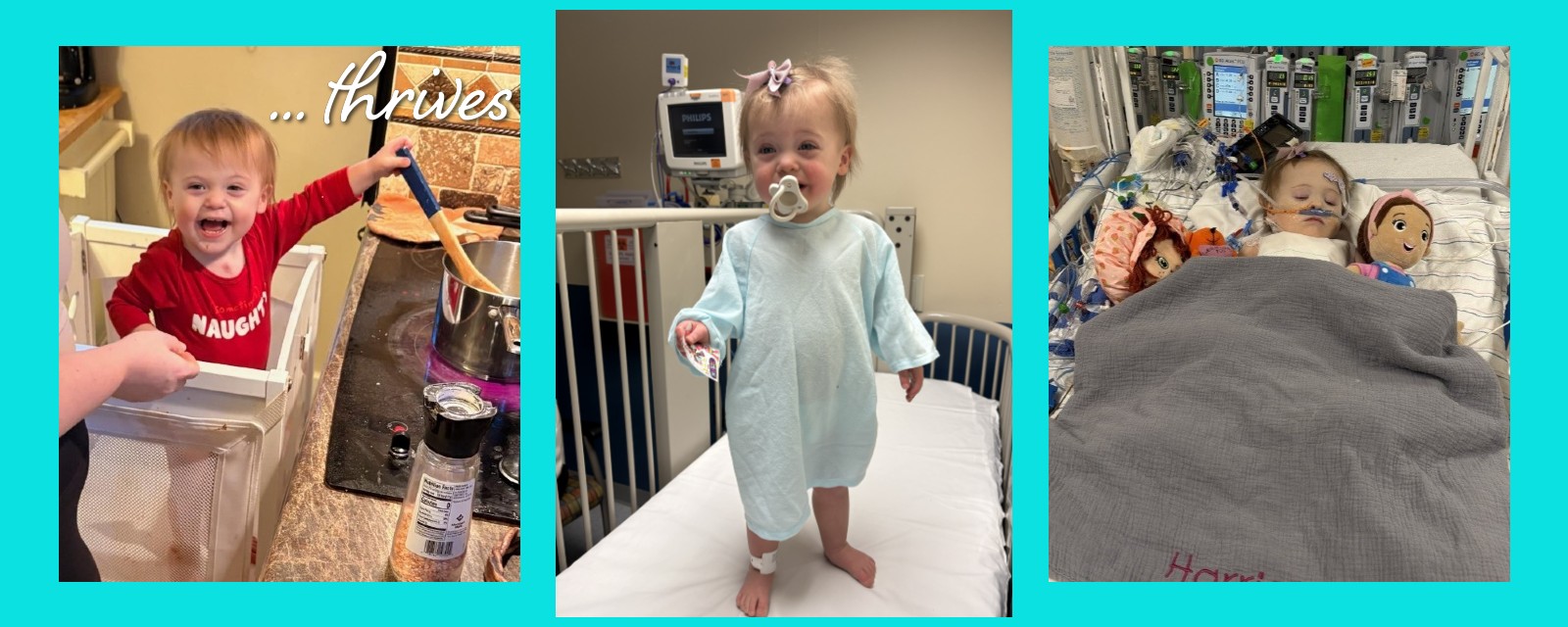
Today, Hattie is at home with her siblings and thriving.
“She’s getting back to her old ways of running and wrestling and doing all the things she used to do,” Dakota said. “It’s the best thing a mom can ask for.”
Hattie’s also curious, spunky and full of personality.
“She’s the happiest girl,” Dakota said. “She loves trucks and cars, but she also loves her hair bows.”
Community support made Hattie’s surgery possible
Surgical Theater was made possible through generous donations from the community. Funding from the Norton Children’s Hospital Foundation helped bring the imaging technology to Norton Children’s, expanding the possibilities for children with the most complex heart and neurological conditions.
For Dakota, gratitude extends even beyond the technology.
“I just cannot express how thankful I am for the team at Norton Children’s,” she said. “The dedication they put into everything — the pre‑op planning, the countless visits, answering every question — they really became like family to us.”
She credits Dr. Alsoufi’s meticulous preparation and the care team’s compassion for making the hardest moments bearable. “Knowing how much effort went into planning her surgery and having the most up‑to‑date imaging and technology before even going into the [operating room] — it made all the difference,” Dakota said. “It was some of the hardest times of our lives, but they made it feel smoother. I can’t thank them enough.”