
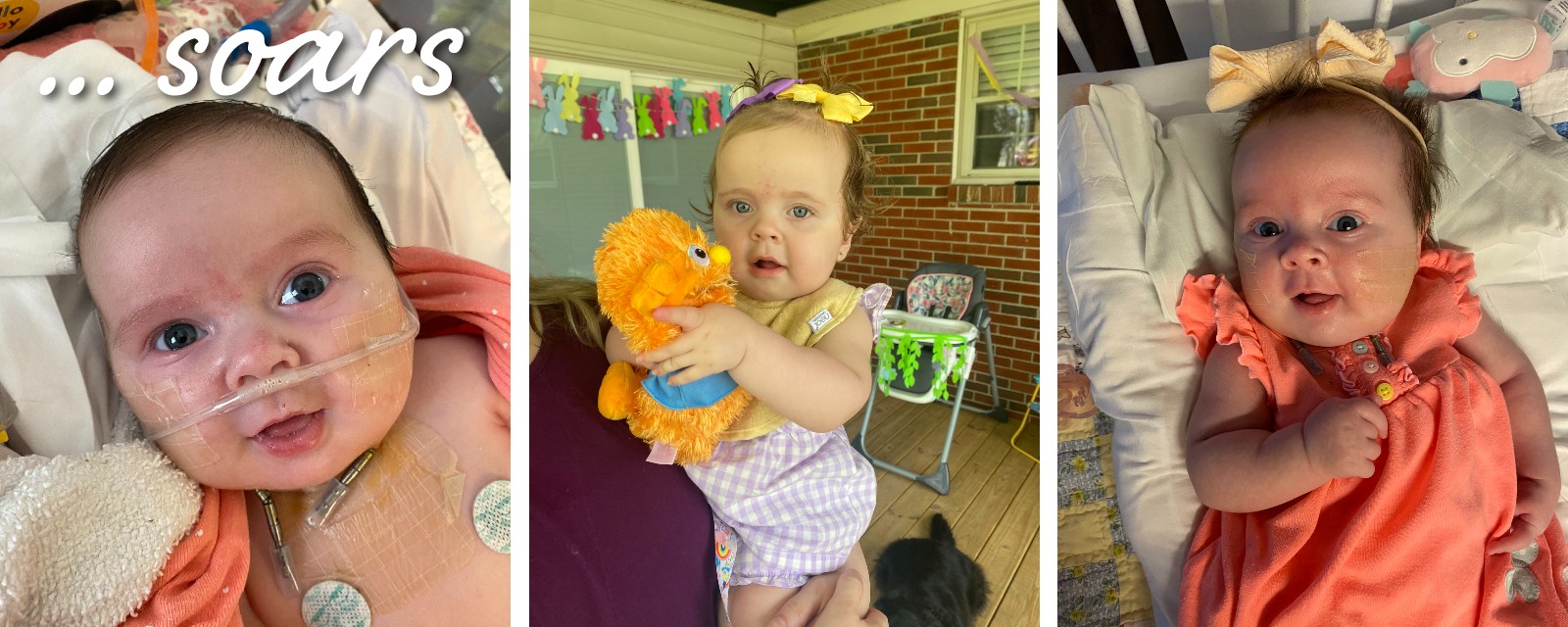
For many parents of newborns, watching their child sleep brings a sense of peace and comfort. But every time Hazel Moore slept in her first few months of life, her mother was filled with fear.
“I would not sleep — like I was so terrified,” said Kalie Roberts, Hazel’s mom. “She would choke a lot. It was really scary.”
Through ultrasound imaging during Kalie’s pregnancy appointments, doctors knew Hazel would face complications at birth but couldn’t be sure of a diagnosis until after she was born. Shortly after being admitted into the Norton Children’s Hospital neonatal intensive care unit (NICU), Hazel was diagnosed with Pierre Robin syndrome, a condition where babies are born with a small, recessed lower jaw that can push their tongue back and block their airway. This can cause dangerous breathing issues, especially during sleep.
“There’s a lethal component to it,” said Mark E. Chariker, M.D., a pediatric plastic surgeon with Norton Children’s. “Infants with this syndrome often experience obstructive sleep apnea. When these newborns relax on their back, their short jaw tends to relax and fall backwards, and being that the tongue is attached, it can actually block their airway. Without intervention, they’re at risk from the very beginning of life.”
Undergoing extensive surgery
“She couldn’t breathe safely on her own. Her only option other than being oxygen dependent was mandibular distraction surgery,” Kaile said. “It was terrifying to hear our newborn needed such an extensive procedure.”
Mandibular distraction surgery involves breaking the jawbone and placing pins along with a device called a distractor. The device, located on the outside of the skin for Hazel’s procedure, is adjusted daily to gradually pull the lower jaw forward.
“We slowly pull the jaw forward until it’s in a better relationship with the upper jaw,” said Dr. Chariker, who performed Hazel’s surgery. “That keeps the tongue from falling back and blocking the airway. Once we reach the desired [jaw] length, we hold it until it solidifies so it maintains proper position going forward.”
Achieving peaceful sleep
Hazel was able to return home to Eminence, Kentucky, to be with her siblings once her jaw was in the correct position. It took a few more months before the device could be removed entirely, allowing Kalie to breathe easier at last, along with her daughter.
“It was a huge sigh of relief to know that chapter was closed,” Kalie said.
Hazel, now a year old, did ultimately require a feeding tube to protect her airway and reduce the risk of food or liquid getting into her lungs. She continues to receive specialty care with Norton Children’s, working toward eating by mouth.
But otherwise, she’s thriving: playing, growing, and breathing freely.
“Hazel is such a happy baby,” Kalie said. “She’s so funny and she loves her brothers. I can’t imagine life without her.”
A family’s gratitude
Kalie continues to be grateful to all the Norton Children’s providers who have been involved in Hazel’s care.
“They’re a godsend,” she said. “I don’t know what we would have done without them. From the doctors to the nurses, they treated us like family. They gave us hope.”
Hazel’s care was a true team effort, involving multiple specialties. Dr. Chariker credits Norton Children’s collaborative care approach for the success of cases like Hazel’s.
“You get close to these families,” Dr. Chariker said. “It’s rewarding to see them go home and live without this constant worry. Breathing and sleeping through the night, things we take for granted, are huge milestones for them.” For Hazel’s family, the simple act of watching her sleep peacefully is now a daily reminder of how far she’s come, made possible through Hazel’s resilience and Norton Children’s expertise in caring for the youngest patients.